
'The market is currently neither cheap enough to be exciting about nor expensive enough to worry about.'

The United States Trade Representative (USTR) has expressed concerns that India's Digital Personal Data Protection (DPDP) Act, particularly the lack of a deemed consent mechanism for credit information companies, and the Information Technology (IT) Rules of 2021, along with frequent internet shutdowns, could negatively impact the ability of US companies to operate and trade in India.
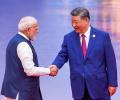
India's dual pursuit of a robust strategic partnership with Washington and a pragmatic, tension-management policy with Beijing represents the essence of modern multi-alignment. By embracing economic pragmatism, learning to compartmentalize political differences, and engaging in continuous dialogue, India can secure its borders, grow its economy, and contribute to a stable, multipolar Asian century, points out Ambassador Rajasekhar.

The Indian stock market's trajectory this week will be significantly influenced by crude oil prices, global market trends, and the commencement of the corporate earnings season, with IT major TCS set to announce its June-quarter results on July 9.

If we really want to curb the further depreciation of the rupee and make the rupee appreciate, we want to come out of the mindset that the exchange rate is merely a number, bring policy corrections to help reduce the outflow of foreign exchange by imposing suitable tariffs to discourage imports and bring self reliance, discipline FPIs, and correcting rules governing royalty outflows, suggests Dr Ashwani Mahajan, National Co-Convenor, Swadeshi Jagaran Manch.

FPIs have already withdrawn Rs 2.6 trillion from Indian equities in 2026, exceeding the outflows recorded in any previous full calendar year.

The Department for Promotion of Industry and Internal Trade (DPIIT) will soon start public consultation for a national retail trade policy, which is likely to include an insurance scheme aimed at providing financial protection against losses caused by theft, accidents or natural calamities. The policy will also spell out ways to give traders access to low-cost finance, promote digital inclusion, and create necessary infrastructure to support them, a senior government official told Business Standard. This is expected to offer relief especially to traditional traders, who are facing stiff competition from large e-commerce players.

Indian benchmark indices Sensex and Nifty surged in early trade, driven by a rally in IT stocks and tempered expectations of US Federal Reserve monetary tightening following softer-than-expected US jobs data. Track Sensex, Nifty on July 3.

'India should understand that we are not going to make the same mistakes with India that we made with China 20 years ago.'


In her address to the nation on the eve of the country's 80th Independence Day, the president stressed that just as government and society remain united to ensure national security, everyone must contribute through joint and concerted efforts to safeguard the present and future of students.

Analysts predict that developments in West Asia, their impact on crude oil prices, and the trading activity of foreign institutional investors (FIIs) will be crucial factors influencing the Indian stock market this week.

Not a single retail outlet ran dry. Every household that wanted a cylinder got one. India faced neither a 1991 moment nor a 2013 one. Macroeconomic stability held. This was not an accident, and it was not luck alone. It was the work of a government that chose to act as it had during the pandemic -- deliberately and gradually, building one measure upon another rather than reaching for a single dramatic lever, explains V Anantha Nageswaran, chief economic advisor to the Government of India.

Monthly gold imports have declined to 25-30 tonnes from 70-80 tonnes while recycling of old jewellery has increased following the recent hike in import duties.

There has never been a moment in India's history when it has been so adrift in the world, so confused about what it stands for and against and so humiliated, asserts Aakar Patel.

The Indian equity market is set for an event-heavy week, with analysts pointing to the Reserve Bank of India's (RBI) interest rate decision, developments in the US-Iran situation, and crude oil prices as the primary determinants of market trends.

The harsh truth is that the US is no longer a reliable partner, cautions Ramesh Menon.
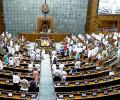
The Congress party is set to challenge the Modi government on a range of critical issues, including alleged theft of Ram temple donations, 'systemic corrosion' of the education system, and constitutional amendment bills related to delimitation and dismissal of ministers, during the upcoming Monsoon Session of Parliament.

Foreign Trade Policy: More incentives for exports, focus on ease of trading

Analysts predict that inflation data, the US Federal Reserve's interest rate decision, and crude oil price trends will be the primary factors influencing the movement of Indian stock markets. Geopolitical developments, particularly the US-Iran deal, and foreign investor activity will also play a crucial role.

The deal shifts the US posture towards India from hostile to neutral, and that matters for growth, points out T T Ram Mohan.

Indian benchmark indices Sensex and Nifty closed marginally lower due to profit-taking, following the Reserve Bank of India's decision to keep the repo rate unchanged while lowering its growth expectations for the current fiscal year and forecasting higher inflation.

US Secretary of State Marco Rubio on Tuesday said the United States would prefer to end its extension of waivers on Russian oil "as soon as possible", while noting that such decisions ultimately rest with the US Treasury Department.

Indian companies' overseas expansion plans are holding strong despite geopolitical tensions in West Asia, driven by structural factors like supply-chain diversification, free trade agreements, and market expansion, according to Ajay Sharma, managing director and head of banking at HSBC India.

An innovation roadmap, a mechanism to double annual bilateral trade within next five years, and a joint artificial intelligence framework were among 13 outcomes to emerge from wide-ranging talks between Prime Minister Narendra Modi and President Emmanuel Macron on Sunday.
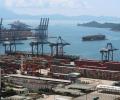
With the Iran war escalating sharply and crisis deepening in the global energy market, India on Monday unveiled a coordinated plan to support exporters and shippers caught in the fallout.

The new foreign trade policy is considered to be less effective.

Notwithstanding the economic complementarities and the host of agreements for deepening economic relation on a host of areas, both sides share common viewpoints on the foreign policy domain and seek common grounds to serve as a counterweight to China, notes Dr Rajaram Panda.

The Indian government has imposed import restrictions on all forms of gold, silver, and platinum articles to prevent misuse of free trade agreements (FTAs). The restrictions apply immediately, regardless of prior contracts or commitments.

The Congress on Sunday lashed out at Prime Minister Narendra Modi over the US' statements after three Indian sailors were killed in American attacks on ships, with party leader Rahul Gandhi saying the "compromised PM" listens "like an obedient servant" and "complies with the orders".

'The flip side of this is that he won't hesitate to call out India if he thinks its policies are hurting US economic interests or border US foreign policy goals.'

Indian liquor brands are increasingly focusing on Hindi heartland states like Uttar Pradesh, Rajasthan, and Haryana as the next major growth engine for premiumisation, driven by expanding luxury portfolios, craft spirit launches, and upgraded retail experiences, as state governments embrace reforms.

The era where nations thrived through rigid alignments is giving way to an age where the connective State defines power. For India, that era has arrived, points out Dr Nishakant Ojha.

Despite decades of efforts towards energy transition, oil will remain the critical energy source for all nations for some decades. We can hope for peace opening the Strait of Hormuz, but must prepare for war closing it, points out former foreign secretary Ranjan Mathai.

Insights from behavioural economics suggest that an ambitious nudge can be effective if three conditions are met, points out Ram Singh Insights from behavioural economics suggest that an ambitious nudge can be effective if three conditions are met, points out Ram Singh, director, Delhi School of Economics.

'Why not aspire for 8 or 9 or even 10 per cent?'

The Asian Development Bank (ADB) has revised down India's GDP growth forecast for fiscal year 2026-27 (FY27) to 6.6 per cent from an earlier 6.9 per cent, primarily attributing the change to elevated energy prices stemming from the Middle East conflict. Despite this moderation, India is still expected to remain the world's fastest-growing major economy.

Ladakh Lieutenant Governor Vinai Kumar Saxena on Sunday approved a new Excise Policy, permitting the sale of hard liquor through retail vends, reducing documents to obtain a licence from 16 to six and extending the liquor availability to four more districts.

US Secretary of State Marco Rubio will visit India for four days to strengthen bilateral relations, holding talks with Indian leaders and attending the Quad foreign ministers' meeting.
